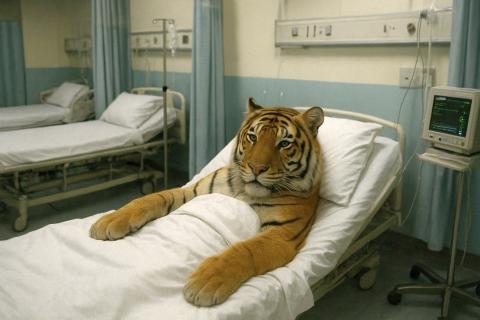
Consulting skills in intensive care: how to become your own tiger
A trauma patient has little or no power or authority in a hospital. They have to find other ways to obtain the best recovery outcome and have their day-to-day needs met.
I learnt this the hard way. I was hit by a motorbike on a pedestrian crossing in Kuala Lumpur. I sustained a smashed vertebra in my neck, some spinal chord damage and sundry less serious injuries. I was lucky to be taken to a good hospital with first-class medical and nursing care; I was told that I might make a full recovery but that it was impossible to predict the eventual outcome and timescales.
I decided to do as much as I could to optimise my recovery. A friend of mine said “You need a tiger in hospital”, someone who fights your corner. I was lucky, I have a friend who is familiar with Malaysian hospital procedures and ensured that I was admitted as smoothly as possible, but I also had to become my own tiger. A big hospital is a busy place and I had to advocate for my day-to-day needs, everything from laundry to laxatives. I found being politely assertive and building a rapport with staff worked best. Effective communication with staff at all levels was important. All staff had some level of English language skills: the top doctors were native-speaker fluent but the personal care assistants who washed me, less so. I found myself learning to speak Malaysian English: “Can change bedsheets?” “Cannot-lah.” On the other hand, with the surgeon in charge of my case I had to discuss whether I met the insurance company’s criteria for being ready to be repatriated and the best place for me to be sent.
I wanted to get as much as possible out of my sessions with the rehab staff, physiotherapists and occupational therapists. Building a rapport with them was very important, and a positive approach combined with a bit of humour helped us get through what were sometimes quite tough 30-minute sessions.
Being hospitalised in another country challenged both my cultural sensitivity and communication skills. There were a couple of car crash moments, mostly around nudity, or what to do if someone is naked or about to become so in the presence of other people. For example, where a British person might leave the room, a Malaysian might turn away and busy themselves with their phone. Malaysians are also very soft-spoken; it is easy as a Brit to come across as loud, if not aggressive.
On reflection, I realise I needed the same skills in the hospital as I needed to run my consulting practice. A consultant seldom has the power or authority to mandate the acceptance of their ideas, they have to use influencing skills. I had to stay resilient in both settings: there were some bad moments in hospital, in particular when I woke up after the operation to secure the broken vertebra in my neck and was told that the surgeon had had to strengthen the front of my neck first, and, as a result,I needed another operation the next day to carry out the procedure they had originally planned. Improvement in the rehab sessions was not always linear: some days I was tired and slipped back a bit. Through it all I tried to maintain a positive and optimistic mindset. It's also helped that I've kept reasonably fit and am used to the discipline of exercise.
Flexibility was important too. The surgeons build their patient management activities round their operating lists but, as in my case, they never know exactly what they will find or how long an operation will take, and an emergency case might have to be fitted in. Rehab staff travel from prior appointments through the unpredictable Kuala Lumpur traffic, and a patient may be talking to a doctor or working with another member of the rehab team when they arrive. Both patient and physiotherapist need to adjust their schedules on the fly. Sometimes the levels of uncertainty felt off the scale: at one point I did not know whether I was going to continue my rehab the following week in the UK or Malaysia, and what type of establishment I would be transferred to.
I will have to draw on my reserves of flexibility for a while yet. The future, and in particular the extent and timescales of my recovery, remain uncertain but I will try to stay positive, put in the rehab work and hope for the best.
Dr Karol Szlichcinski FIC is a member of the CMCE Leadership Team